End of Heat
Overview
The End of Heat, is the 14th solar term in the traditional Chinese calendar, marking an important seasonal transition. This solar term signifies the end of the intense summer heat and the gradual onset of autumn. This period of time typically spans from late August to early September. The End of Heat is known for a variety of cultural and agricultural activities and is deeply embedded in Chinese tradition and lifestyle, signifying a shift in weather patterns and agricultural practices.
Climate and Weather Patterns
The arrival of the End of Heat indicates that the sultry summer weather is starting to wane, and cooler temperatures are on the horizon. Although autumn is approaching, regions, particularly in Southern China, may still experience occasional bouts of summer heat referred to as "autumn tigers." This is a period marked by fluctuating temperatures where cooler nights become more frequent.
Cultural Significance and Traditions
It is part of a broader categorization known as the 24 solar terms, which were designed to guide agricultural activities throughout the year. The solar terms were based on the observation of celestial movements and nature's cycles, with each term corresponding to specific climatic conditions.
The term "Chu Shu," which originally meant "taking a break" or resting, evolved to indicate the end of the sweltering summer and the beginning of cooler autumn days.
Agriculturally, the End of Heat is a crucial time as it heralds the busy harvest season. Farmers across China prepare for harvesting crops like millet, rice, and sorghum, which become ripe during this time. This period also coincides with various ceremonies and expressions of gratitude to the land, acknowledging the bounty of the harvest.
Ancestor Worship and Festivals
One of the notable cultural practices during the End of Heat is ancestor worship, which is closely tied to the Zhongyuan Festival, also known as the Ghost Festival. This festival falls on the 15th day of the seventh month in the Chinese lunar calendar, overlapping with the End of Heat. It is a time for paying respects to deceased ancestors through various rituals, including the floating of water lanterns. These lanterns, shaped like lotus flowers, are set adrift in rivers to honor the spirits and guide them in the afterlife.
Culinary Traditions
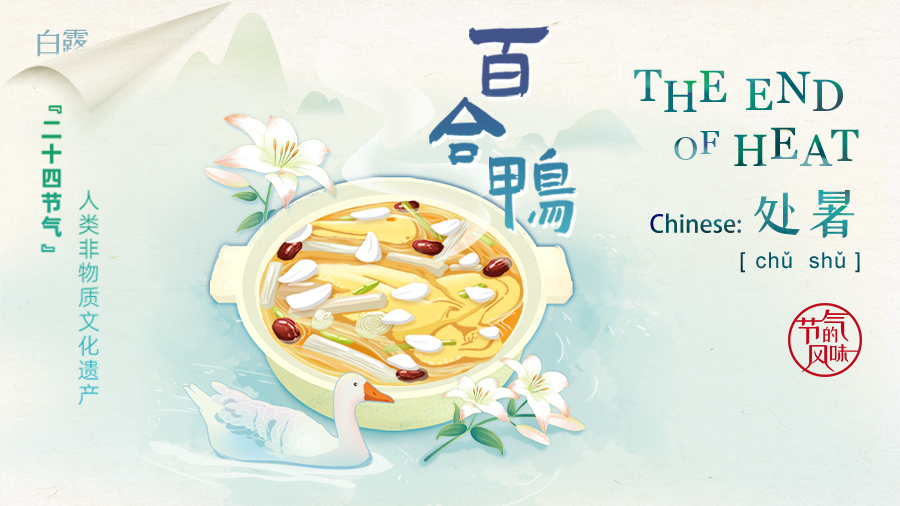
In traditional Chinese medicine, the transition from summer to autumn calls for a change in diet to balance the body's internal energies. Cooling foods, which are believed to clear excess heat from the body, become popular during the End of Heat. Duck meat, considered a "cooling" food, is especially favored during this time, with a variety of preparations like roasted duck or duck soup available. Additionally, Tremella lily lotus seed soup is a popular dish during this time, valued for its moisturizing properties, which help counteract autumn dryness and protect the lungs.
Observing Nature
The End of Heat is also a time for observing changes in nature. The night-blooming cereus, a mysterious flower, often blooms during this period. Known for its fragrant, ephemeral blossoms that open at night and wilt by morning, this flower adds a touch of mystery to the season. Additionally, the cooling season invites people to enjoy the visual spectacle of clouds forming various shapes in the sky, a natural phenomenon celebrated in Chinese culture.
Fishing Season Festival
The End of Heat marks the beginning of the fishing season for coastal regions in China. With the lifting of the fishing ban, fishermen celebrate a bountiful harvest from the sea. The Fishing Season Festival, held along the coastlines of the East China Sea, is a jubilant event where people indulge in a variety of seafood delicacies.
Health Practices
The End of Heat also prompts a shift in lifestyle to accommodate the changing weather. Autumn weariness is a common phenomenon during this time, as people feel exhausted after the energy-draining summer months. Adequate rest, mild exercise, and indoor plants are recommended to combat fatigue and rejuvenate the body.
In terms of health, it is essential to guard against the dryness typically associated with autumn. Traditional Chinese medicine suggests consuming foods that moisturize the lungs and protect the respiratory system. Ingredients like lentils, pumpkin, millet, bayberry, and honey are recommended for their health benefits, supporting overall well-being during this seasonal transition. Article reference1. 24 Solar Terms: 6 things you may not know about End of Heat. chinadaily.com.cn. 20242. End of Heat: Things you shouldn't miss. chinadaily.com.cn. 20183. Enjoy a bowl of tasty soup to welcome autumn. chinadaily.com.cn. 2018Photo Gallery(6 pictures)CategoriesLifestyleTag24 Solar TermsIntangible Cultural HeritageRelatedTraditional Chinese Medicine24 Solar TermsCatalogue1. Overview2. Climate and Weather Patterns3. Cultural Significance and Traditions4. Health Practices- - - []








